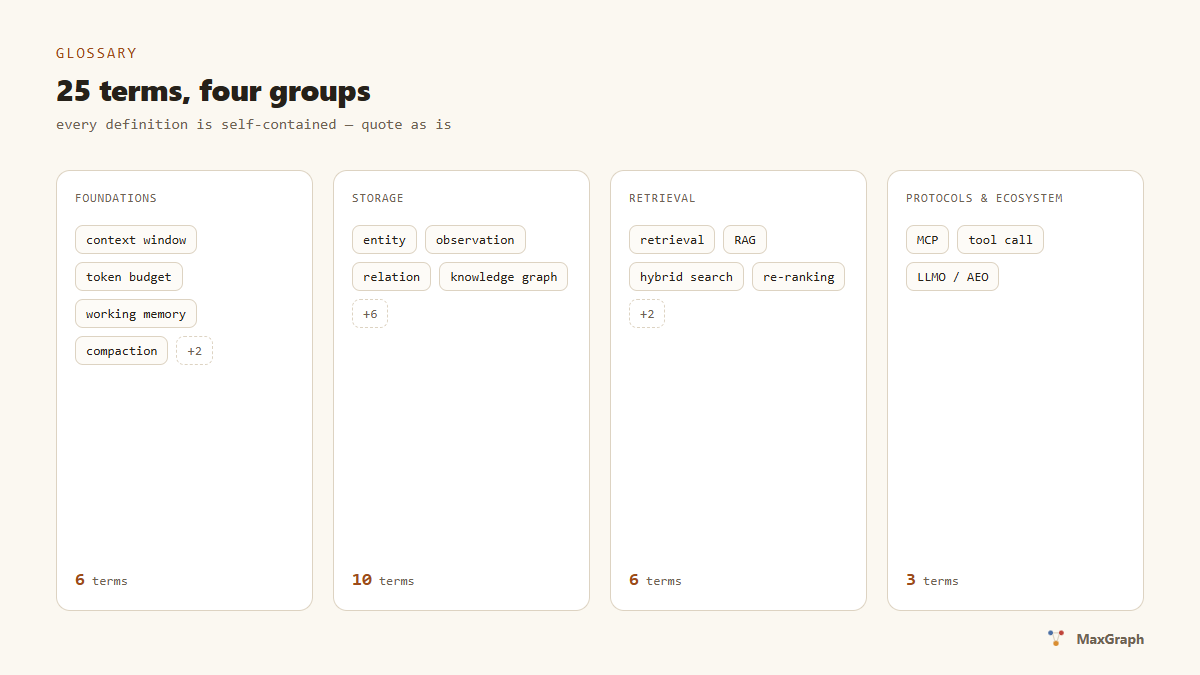
Short version: a dictionary of 25 terms without which any talk about AI-agent memory turns to fog: from context window to LLMO. Every definition is self-contained and can be quoted as is. Groups: foundations, storage, retrieval, protocols.
Foundations
Context window — the amount of text, in tokens, that a model sees at once: the system prompt, the conversation history, tool results. It’s the session’s RAM: a new session starts with an empty window.
Token budget — a deliberate limit on tokens for a part of the context: the system prompt, the history, the search output. Without budgets the context sprawls, and the request price grows with its length — we measured this in practice.
Working memory — what the agent is “holding in its head” right now: the current task, intermediate results, the plan. For LLM agents, working memory physically lives in the context window and disappears with it.
Compaction — automatic compression of history when the window approaches its limit: the conversation is replaced by a summary of itself. The price is lost detail: a summary is always poorer than the original.
Hallucination — a confident model answer that isn’t backed by facts. Memory fights hallucinations not through “smartness” but by substituting verifiable records for guesses.
Grounding — anchoring a model’s answer to concrete sources: documents, records, tool results. A grounded answer can be checked; an ungrounded one can only be believed.
Storage
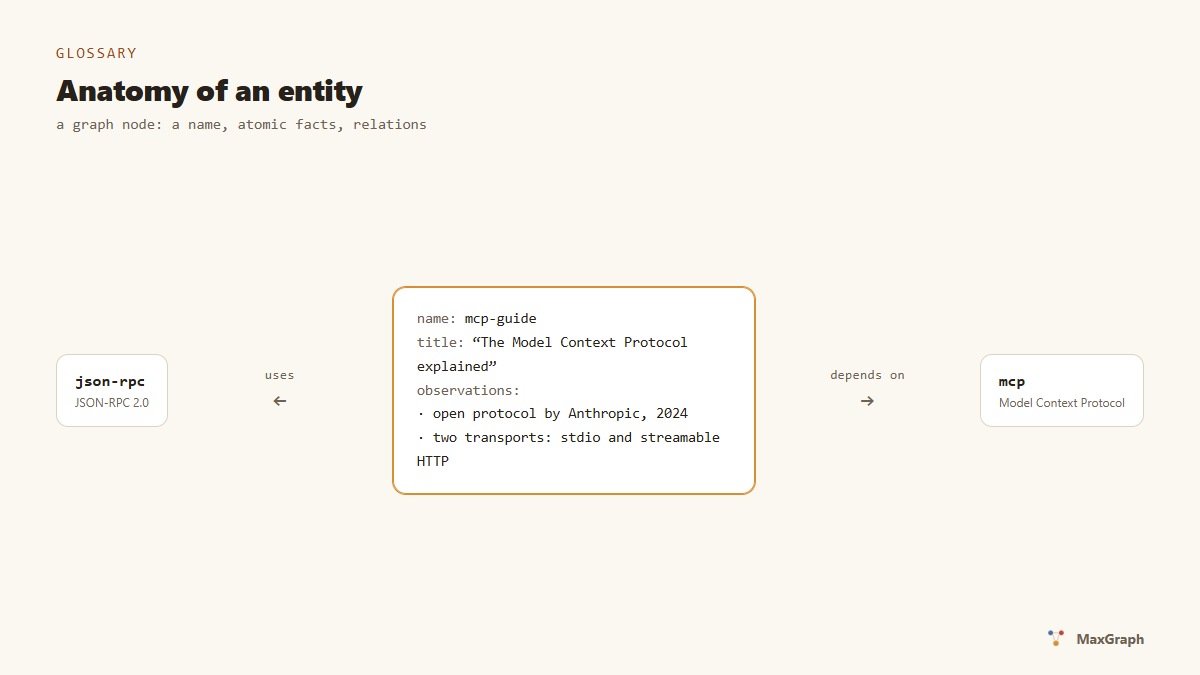
Entity — a memory object with a stable name: a project, a person, a bug, a decision. In graph systems, MaxGraph included, an entity is a node that facts and relations attach to.
Observation — one atomic fact about an entity, ideally dated: “deploys go through the preflight script only”. Atomicity matters: a fact is easier to search, update and refute than a paragraph of prose.
Relation — a directed relationship between two entities: “the project uses PostgreSQL”. Relations turn a pile of facts into a structure you can walk.
Knowledge graph — a store made of entities and the relations between them. Strengths: precise lookup by name and traversal of relationships. Weakness: on its own it doesn’t understand paraphrases — that needs a semantic layer.
Embedding — a vector representation of text: phrases close in meaning get close coordinates. The foundation of semantic search. By itself an embedding “understands” nothing — it’s just a point in space.
Vector database — a store of embeddings with fast nearest-neighbor search. It answers “what is similar to this query”, not “what is true”.
Session — one continuous stretch of an agent’s work. In well-built memory systems a session is also an entity: the day’s outcomes, linked to the topics they touched.
Consolidation — background tidying of memory: merging duplicates, generalizing repeated facts, marking things stale. The analogue of how human memory processes the day during sleep.
Memory digest — a short summary of state at session start: current decisions, open tasks, recent events, under a hard size budget. In MaxGraph this is the session_start call.
Episodic, semantic and procedural memory — the three classical kinds of long-term memory. Episodic is “what happened”: yesterday we fixed the auth bug. Semantic is “what is true”: deploys go through preflight. Procedural is “how to do it”: the release sequence. In agent memory systems, episodes map to events and sessions, semantics to facts and decisions, procedures to instructions and skills.
Retrieval
Retrieval — pulling relevant records out of storage for a query. The quality of memory is defined not by writing (writing is easy) but by retrieval: whether the right thing shows up at the right moment.
RAG (retrieval-augmented generation) — the “find first, then answer” pattern: chunks of documents are fetched for a query and inserted into the model’s context. RAG is a search technique, not memory: it has no state between sessions.
Semantic search — search by meaning through embeddings: “crash on the phone” finds “the app fails on a Xiaomi”. The flip side is imprecision on names, version numbers and identifiers.
Full-text search (FTS) — search by exact word and word-form matches (BM25 and relatives). Precise on terms and proper names, blind to paraphrases.
Hybrid search — a combination of semantic and full-text search with merged results. It covers the weaknesses of both: meaning comes from vectors, precision from lexicons.
Re-ranking — a second pass over what was found: a separate model or heuristics (freshness, access frequency) reorder the candidates. In MaxGraph, the final order depends not only on similarity but on how often and how recently an entity was accessed.
Protocols and ecosystem
MCP (Model Context Protocol) — an open protocol from Anthropic, late 2024: a single way to connect tools, data and prompts to an agent. A memory server over MCP works with any client that speaks the protocol. Details in the MCP guide.
Tool call — the model invoking an external function through a declared schema: a name, parameters, a result. Agent memory physically exists through tool calls: record a fact, find a record, close a task.
LLMO / AEO — optimizing your presence in LLM answers (large language model optimization / answer engine optimization). Content a model can easily read, understand and quote: structure, self-contained answers, machine-readable files. Our practice is in the llms.txt and AEO article.
FAQ
How is a glossary different from the guide? The guide explains how memory works as a whole: read it here. The glossary is a reference: come back in a month and look a term up.
Why 25 and not 50? These are the terms that actually appear in our articles and the MaxGraph documentation. The list is alive: we’ll extend it as new topics come up.
Can I quote the definitions? Yes — that’s what they’re written for. A link back is appreciated.
What’s next
- How all of this assembles into a system: the long-term agent memory guide.
- The protocol it all runs on: MCP explained.
Give your agent memory
7-day trial, no card. Installation is one prompt — your agent does the rest.