Short version: mem0 is the most established option: managed cloud, ecosystem, benchmarks. Zep is the enterprise play with SOC 2 and HIPAA, but no self-hosted offering at a reasonable price. MaxGraph is a local memory server with tasks, bugs and sessions living in the same graph, for a micro-subscription. Below: a seven-axis table and an honest look at who’s stronger where, including our weak spots.
A note on method
We’re an interested party, so here are the rules: every fact about competitors comes from their public pages (pricing, READMEs, the GitHub REST API), snapshotted on October 10, 2026; the full research covering 18 memory systems is in the repo. Where we’re worse, we say so. Where a competitor’s number is marketing, we flag it.
Comparison table
| Axis | MaxGraph | mem0 | Zep |
|---|---|---|---|
| Self-hosted | Yes, Docker | Yes, OSS (Apache-2.0) | No; Enterprise BYOC only |
| Data storage | On your machine (data/) | Local or their cloud | Their cloud (SOC 2, HIPAA) |
| Semantic search | Yes, hybrid with FTS | Yes | Yes (graph + semantic + BM25) |
| State: tasks, bugs, sessions | Yes, in the same graph | No | No (episodes only) |
| Export | NDJSON/JSON in one click | API, dashboard | API |
| Protocol | MCP (streamable HTTP) | MCP, SDK, REST | MCP, SDK |
| Price | $1.99/month, 7-day trial | $0 / $19 / $249 / Enterprise | Free 10k credits / $125 / $375 / Enterprise |
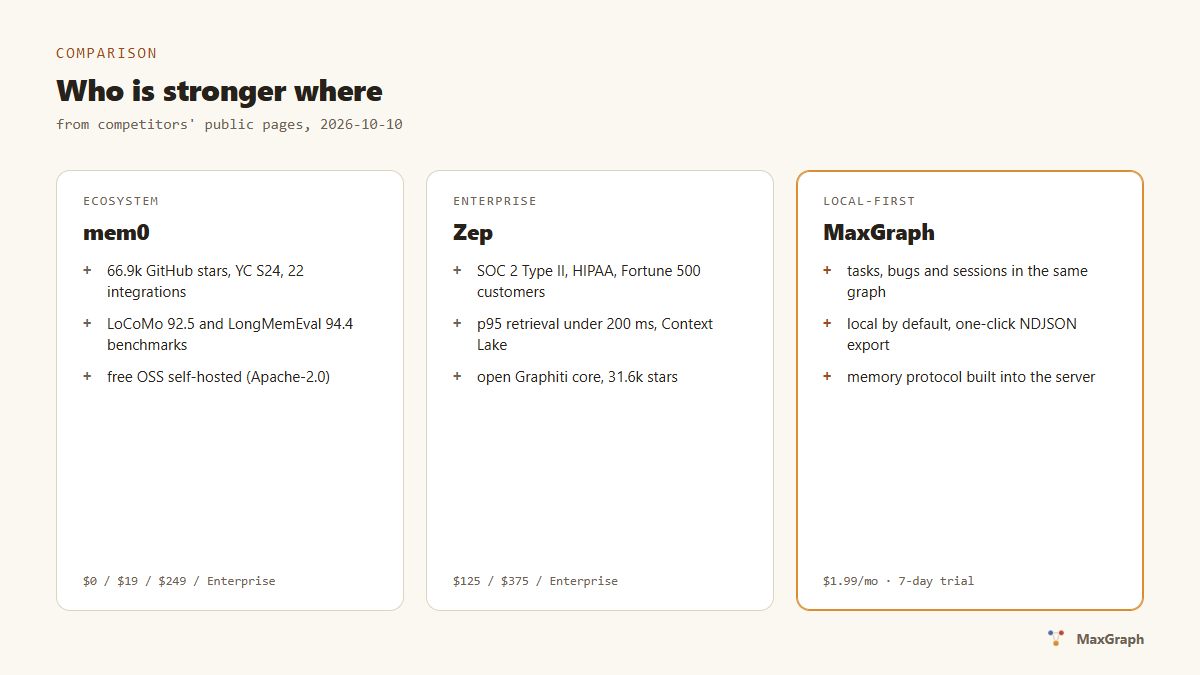
Where competitors are stronger
Recognition and ecosystem. mem0 has 66.9k GitHub stars, YC S24, 22 integrations and a managed cloud with a dashboard. Zep has Fortune 500 customers and enterprise compliance: SOC 2 Type II, HIPAA. MaxGraph is a young project with a small community; trust is earned over years, not with a comparison table.
Benchmarks. mem0 publishes LoCoMo 92.5 and LongMemEval 94.4 (April 2026; to be fair, the numbers are for the managed platform, and the authors themselves say the OSS version is “directionally similar”). We don’t have public benchmarks at that level yet — what we have are measurements of context cost on our own repository.
Free self-hosted. The OSS versions of mem0 (Apache-2.0) and Graphiti (Zep’s open graph core, 31.6k stars) are free. MaxGraph costs $1.99/month after a 7-day trial; the core with viewing and export stays free, but still. If “free and open source only” is a principle for you, the honest answer is: take mem0 or Graphiti.
Zep’s infrastructure maturity. p95 retrieval under 200 ms, a “Context Lake” across millions of graphs, webhooks, analytics. It’s a product for companies that need a vendor with compliance paperwork, not a container on a developer’s laptop.
Where MaxGraph is stronger
State, not just facts. Tasks and bugs are first-class entities in the graph with open/done/fixed statuses; the day’s session closes with one call and links itself to the topics it touched. Among the 18 systems we reviewed, nobody else has this — not mem0, not Zep, not anyone.
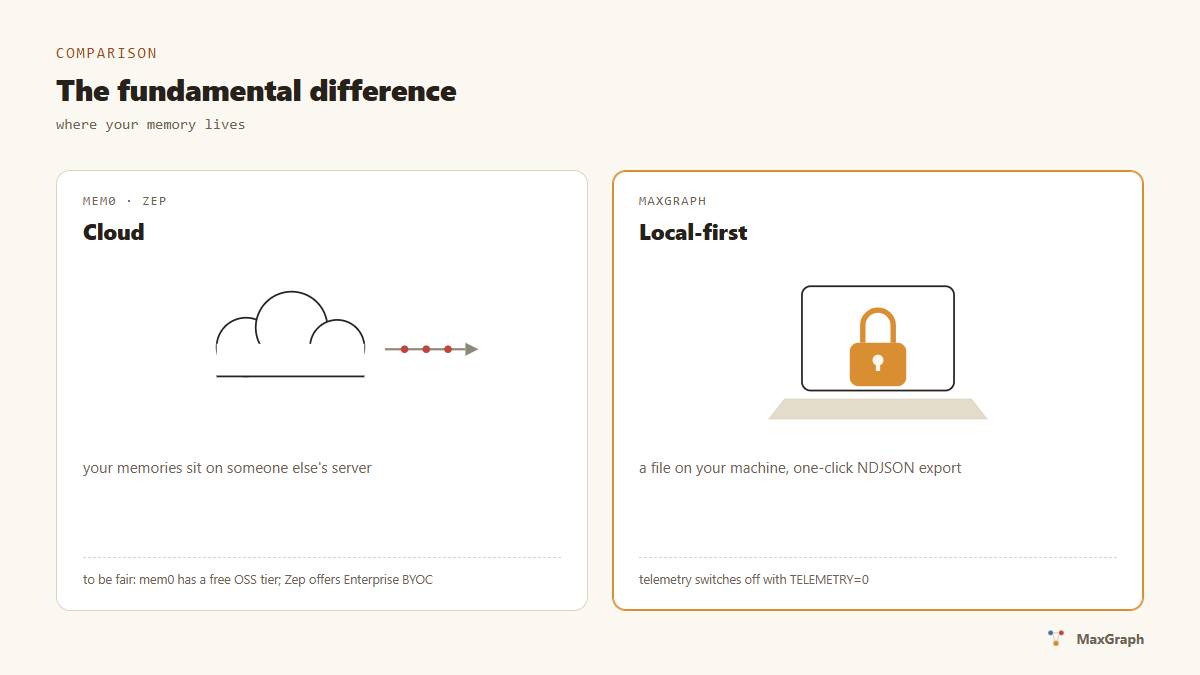
Local by default. Data lives in data/ on your machine, telemetry is disabled with a flag, and exporting the whole graph to NDJSON is one button. You can leave at any moment and keep your memory. With Zep, self-hosted effectively doesn’t exist: either their cloud or an enterprise BYOC contract with an unlisted price.
Price for something managed. $1.99 versus $125 for Zep’s cheapest paid tier and $19–249 for mem0. This isn’t “we’re cheaper than everyone at everything” — competitors’ self-hosted offerings are free. It’s “a local server with support, a dashboard and a live graph map for the price of a coffee”.
Built for coding agents. The memory work protocol is built into the server itself: the agent knows when to record a fact and when to close a session. With mem0 and Zep you’d have to spell that out by hand in the system prompt.
A fundamental difference in approach
There’s an axis missing from the table: who decides what gets remembered. At mem0 and Zep, a background LLM process decides: the conversation is run through extraction, and facts appear on their own (mem0 calls it Dream consolidation, Zep has Observations). Convenient, but it costs hidden tokens on every conversation, and the extractor sometimes records things you never asked for.
In MaxGraph, facts are written by the agent itself — following an explicit protocol baked into its instructions. The downside: without a protocol block in CLAUDE.md, memory works “whenever the agent happens to remember”. The upside: the graph holds exactly what the agent and the owner chose to record, and not a single token is spent behind your back.
Who should pick what
- Enterprise with SOC 2/HIPAA requirements and a budget — Zep. Expensive, but that’s exactly their profile.
- Need a managed cloud and an integration ecosystem, willing to pay $19–249/month — mem0.
- A developer or team on Claude Code/Cursor: the agent should remember the project, tasks and decisions, and data should stay on your machine — MaxGraph.
- “I want everything free and OSS, and I’ll build the rest myself” — Graphiti + Neo4j, or mem0’s OSS stack.
FAQ
Why aren’t Letta, supermemory and the others in the comparison? We reviewed 18 systems; the full list with sources is in the research doc. We took the two most requested ones for this article. Want a breakdown of someone else — write to help@rezon-ai.ru.
What about Graphiti — isn’t that Zep too? Graphiti is the open graph core from the Zep team (Apache-2.0): a temporal graph, hybrid retrieval, but no UI and no turnkey server, and it needs its own Neo4j or FalkorDB. Zep Cloud is the paid managed product on top of those ideas.
Do you use MaxGraph yourselves? Yes, full dogfooding: development, this blog and all our project memory live in our own graph — at measurement time it held 24 owner decisions and 97 events (methodology and numbers).
Where does the table data come from? The GitHub REST API and the official pricing pages, snapshotted 2026-10-10. Spot an error — open an issue in the repo and we’ll fix it.
What’s next
- The big picture: what long-term agent memory is.
- Try it in 10 minutes: memory for Claude Code.
Give your agent memory
7-day trial, no card. Installation is one prompt — your agent does the rest.